


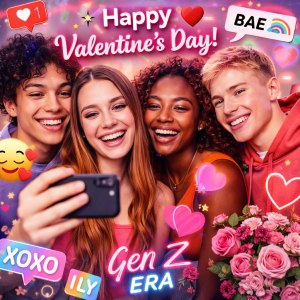
Every year, the world celebrates February 14 as Valentine’s Day, turning its attention to love. In 2026, Valentine’s Day falls on Saturday, February 14—a perfect weekend for celebration. Across ountries worldwide, flowers are delivered, chocolates exchanged and heartfelt messages shared.
For Gen Z, a generation shaped by social media, digital connection and cultural diversity, Valentine’s Day is more than a romantic ritual—it is a redefinition of love itself. But behind the Instagram posts and aesthetic gift boxes lies a centuries-old story rooted in faith, history and tradition.
Who Was St. Valentine?
The origins of Valentine’s Day trace back to Saint Valentine, a Christian figure whose life is wrapped in legend. The Catholic Church recognizes at least three saints named Valentine or Valentinus who were martyred in the third century A.D.
One popular account links him to the reign of Claudius II Gothicus, who reportedly banned young men from marrying, believing single men made stronger soldiers.
Valentine, defying the emperor’s decree, secretly performed weddings for couples in love. When his actions were uncovered, he was executed.
Another story describes Valentine as a bishop from Interamna (modern-day Terni, Italy), also martyred for his faith. A further legend claims he sent a farewell letter to a young woman he befriended while imprisoned, signing it “From your Valentine”—a phrase that survives today.
For Gen Z, often skeptical of institutions but deeply invested in authenticity, these stories highlight the holiday’s core message: love is courageous, sacrificial and worth standing up for.
From Pagan Festival to Christian Feast
Long before roses and greeting cards, mid-February in ancient Rome was marked by Lupercalia, celebrated on February 15. Dedicated to Faunus, the Roman god of agriculture, and to Rome’s legendary founders Romulus and Remus, Lupercalia was a fertility festival welcoming spring.
As Christianity expanded, pagan festivals were reformed or replaced. In the late fifth century, Pope Gelasius I declared February 14 as St. Valentine’s Day, effectively Christianizing the period. Though historians debate how directly the two events are connected, the shift symbolizes a transformation—from ritual fertility rites to a celebration grounded in spiritual and emotional love.
For Gen Z, this evolution mirrors their own reinterpretation of traditions: reshaping inherited customs into something meaningful for their time.
Valentine’s Day became firmly associated with romantic love during the Middle Ages. In England and France, it was believed that birds began choosing their mates on February 14. The English poet Geoffrey Chaucer helped cement this connection in his poem “The Parliament of Fowls,” linking St. Valentine’s Day with romantic pairing.
The tradition of written valentines followed. In 1415, Charles, Duke of Orleans composed one of the earliest surviving Valentine messages while imprisoned in the Tower of London. By the 17th and 18th centuries, exchanging handwritten notes became common in England.
With the rise of printing technology in the 19th century, printed cards replaced handwritten letters. In America, Esther A. Howland popularized mass-produced valentines, earning the nickname “Mother of the Valentine.” Today, more than 145 million Valentine’s Day cards are sent annually in the United States alone.
No Valentine’s Day is complete without Cupid—the winged cherub aiming arrows of love. Cupid traces his roots to Eros, the Greek god of love. Originally portrayed as a powerful and handsome immortal influencing gods and mortals alike, Eros later evolved into the playful, chubby child commonly seen on modern cards.
For Gen Z, Cupid may appear in memes, digital stickers or animated emojis, yet the symbolism remains unchanged: love strikes unexpectedly and transforms lives.
Valentine’s Day Across Nations: A Shared Celebration
While often associated with the United States, Valentine’s Day is celebrated globally—in Canada, Mexico, the United Kingdom, France, Australia and beyond.
Though customs vary, the essence remains universal:
Couples celebrate romance and commitment.Friends exchange appreciation.Families express affection.
Communities host themed events and gatherings.
In the Gen Z era, the celebration has expanded further. It now includes “Galentine’s” gatherings, self-love rituals, digital love notes and public affirmations of friendship. Social media platforms amplify expressions of affection, but they also encourage inclusivity—celebrating all forms of love, not just romantic partnerships.
The True Definition in the Gen Z Generation
For Gen Z, Valentine’s Day is no longer confined to candlelit dinners or traditional courtship. It represents:
Authenticity – expressing genuine emotion rather than performing for appearance.
Inclusivity – recognizing friendships, chosen family and diverse relationships.
Self-love – prioritizing mental health and personal growth.
Love That Transcends Time
From the martyrdom of Saint Valentine to medieval poetry, from ancient Roman festivals to TikTok tributes, Valentine’s Day has continually evolved. Yet its essence endures.
In the Gen Z era, the holiday is being redefined—not abandoned. It is celebrated across nations not merely as a commercial event but as a reminder that love—romantic, platonic, familial and self-directed—is essential to human life.

