


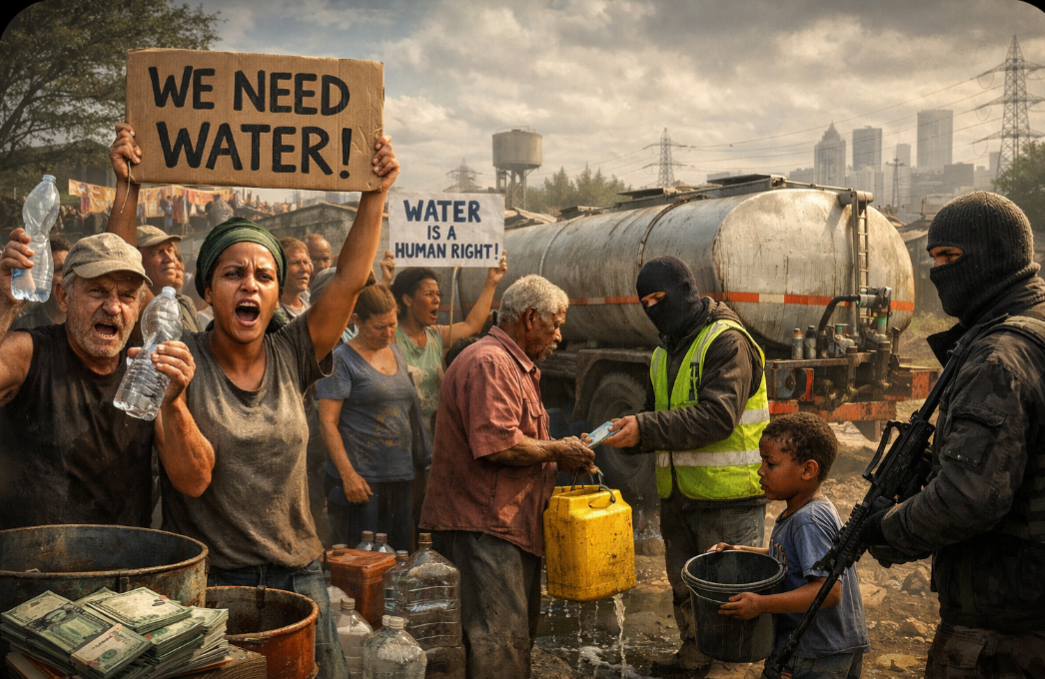
 Mounting water shortages across parts of Johannesburg and surrounding areas are not only testing residents’ resilience but also creating fertile ground for criminal networks accused of exploiting the crisis for profit.
Many residents in northern Johannesburg, an area often associated with affluence and greenery, say taps have run dry for weeks, leaving households in dire conditions.
Locals describe the situation as both a public health concern and a violation of constitutional rights. With no steady water supply, daily routines—from personal hygiene to household chores—have been severely disrupted, raising fears of disease outbreaks and deteriorating living standards.
The crisis echoes the recent energy challenges that plagued South Africa, where prolonged power outages—commonly referred to as load shedding—crippled economic activity and daily life. Analysts have long attributed those blackouts to chronic underinvestment in aging infrastructure, a factor now increasingly linked to the country’s water woes.
Beyond Johannesburg, the situation is even more acute in Hammanskraal, where residents have endured erratic water access for years. In some communities, taps have remained dry for months, forcing families to depend on water tankers for survival. The lack of reliable supply has placed immense pressure on households, particularly those with children.
Amid this scarcity, allegations have surfaced of so-called “water mafias” infiltrating the system. According to experts and community members, these groups are accused of manipulating municipal contracts and sabotaging infrastructure to prolong lucrative water delivery deals. In some instances, tanker operators reportedly demand payment for water that is meant to be distributed free of charge.
Residents claim that the situation has fostered a climate of fear, with some reluctant to speak out against these practices for fear of losing access to water altogether. The emergence of such networks has reportedly been more pronounced in provinces like KwaZulu-Natal and the Eastern Cape, where infrastructure challenges and climate-related disasters have worsened supply gaps.
Authorities, including President Cyril Ramaphosa, have acknowledged the issue, calling for decisive action against criminal elements exploiting the crisis. However, critics argue that enforcement efforts have fallen short, allowing the problem to persist.
Experts maintain that while criminal syndicates exacerbate the crisis, the root cause lies in years of neglect and insufficient investment in water systems. Aging infrastructure, population growth, and climate pressures have combined to stretch resources beyond capacity.


