


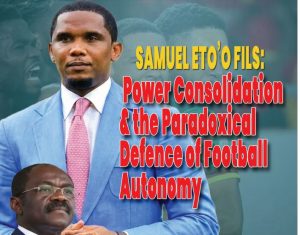
Samuel Eto’o Fils has served a masterclass of political subterfuge that would elicit explicit disapproval‚ yet‚ implicit admiration from the most seasoned proponents of power consolidation in Yaoundé’s corridors of power. Eto’o Fils has staged a putsch that simultaneously cuts to size the Cameroonian sports ministry while ostensibly upholding the sacred principles of football federation autonomy. The irony is as palpable as it is instructive: Cameroon’s most celebrated footballer has become the most adept practitioner of the very rigidly high-horse governance structures reminiscent of Paul Biya’s four-decade stranglehold on the nation.
Following his resounding re-election on November 29, 2025‚ securing an almost North Korean-esque mandate of 85 out of 87 votes‚ Eto’o moved with the alacrity and ruthlessness characteristic of his home regime itself. Within days, Belgian coach Marc Brys was summarily dismissed, a comprehensive purge of the technical staff executed, and David Pagou installed as the new helmsman, all mere weeks before the Africa Cup of Nations. The FECAFOOT president’s litany of accusations against Brys‚ to wit: insubordination, commercial violations, and the nebulous charge of “inciting players to defy FECAFOOT‚” reads like a transcript from one of Yaoundé’s numerous show trials against political dissidents.
Yet herein lies the exquisite paradox: Eto’o’s machinations, however autocratic in execution, find justification in the sacrosanct FIFA Article 15(c), which mandates that member associations operate autonomously, immune from governmental interference. The Belgian tactician’s appointment by Minister of Sports Professor Narcisse Mouelle Kombi in April 2024‚ a unilateral ministerial fiat that bypassed FECAFOOT entirely‚ constituted a flagrant violation of international football governance standards. When Brys was unveiled without Eto’o’s imprimatur, the federation president’s conspicuous absence and subsequent confrontational encounter with the coach presaged the inevitable denouement.
The sports ministry’s transgression was not merely procedural but philosophical, representing the precise species of governmental overreach that has precipitated FIFA suspensions in Nigeria, Kuwait, India, and Zimbabwe. These precedents establish an unambiguous jurisprudence: regardless of a government’s financial contributions or statutory authority, football federations must retain operational independence. The ministry’s presumption that “he who pays the piper calls the tune‚” fundamentally misconstrues the covenant between FIFA and its 211 member associations.
Eto’o, whether through perspicacity or instinct, recognised that the ministry had provided him with an unassailable legal and moral position. By invoking FIFA’s autonomy provisions, he could simultaneously consolidate his personal hegemony and present himself as the defender of international football governance principles. It is precisely the modus operandi perfected by the Biya administration: the appropriation of democratic rhetoric to legitimise authoritarian practice.
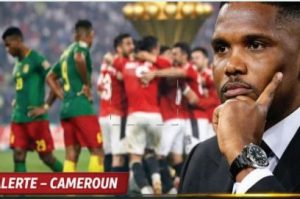
The parallels between Eto’o’s FECAFOOT and Biya’s Cameroon are unnervingly precise. The latter has ruled since 1982, eliminating presidential term limits in 2008, reportedly manipulating elections with brazen impunity, and maintaining power through a sophisticated architecture of patronage, elite co-optation, and strategic appointments. Eto’o’s recent cabinet reshuffling at FECAFOOT‚ installing loyalists from technical director Martin Ndtoungou Mpile down to kit manager Pierre Arnold Ebolo‚ mirrors Biya’s perpetual ministerial rotations designed to forestall the consolidation of independent power bases.
The dismissal of established internationals such as Captain Vincent Aboubakar, goalkeeper André Onana, and Choupo-Moting from Pagou’s inaugural squad demonstrates another shared characteristic: the subordination of meritocratic considerations to political imperatives. When Pagou declared his intention to “restore discipline” and create “a new image,” channeling his military family heritage, one hears unmistakable echoes of every authoritarian’s favorite justification for purges: the restoration of order and the elimination of insubordination.
Yet the Ministry of Sports must shoulder considerable culpability for this debacle. By appointing Brys without FECAFOOT consultation, the ministry violated FIFA statutes which explicitly prohibit such interference. This was not mere procedural irregularity but an existential threat to Cameroon’s FIFA membership. The ministry’s subsequent refusal to acknowledge its error‚ continuing to pay Brys’s salary even after FECAFOOT’s dismissal, creating the surreal spectacle of two competing national team squads‚ reveals either stunning ignorance of international football governance or contemptuous disregard for it.
Brys’s characterisation of Eto’o’s re-election‚ noting that “there weren’t any other candidates‚” while perhaps intended as sardonic commentary, inadvertently highlights the systemic problem. In Cameroon’s political ecosystem, whether at the presidential palace or the football federation, uncontested elections have become the norm rather than the aberration. The opposition’s fragmentation and intimidation ensure that genuine competition remains chimeric.
Nevertheless, the case for FECAFOOT autonomy extends beyond Eto’o’s personal ambitions to encompass the Indomitable Lions’ competitive prospects. History demonstrates unequivocally that ministerial interference correlates inversely with national team performance. When political considerations supersede technical expertise in personnel selection, mediocrity inevitably ensues. The appointment of coaches based on governmental whim rather than federation assessment creates instability, undermines tactical continuity, and demoralises players caught between competing authorities.
If FECAFOOT operates with genuine independence‚ not merely independence from the ministry but also from the federation president’s personal caprices‚ the national team’s probability of success increases substantially. This requires institutional structures with genuine checks and balances, transparent selection criteria, and decisions predicated on footballing merit rather than political loyalty. Regrettably, Eto’o’s consolidation of personal power suggests that FECAFOOT autonomy from the ministry may simply create a different species of autocracy rather than genuine institutional governance.
The broader implications transcend Cameroonian football. Across the African continent, governments routinely conflate financial support with operational control, precipitating recurring confrontations with FIFA. The ministerial argument‚ that state funding entitles governmental oversight‚ possesses superficial logic but fundamentally misapprehends the rationale for federation autonomy. Football’s global governance architecture depends upon uniform standards, consistent regulations, and insulation from the vicissitudes of political interference that vary dramatically across jurisdictions.
Marc Brys’s observation that “this doesn’t happen anywhere else in the world” reflects his European sensibilities but overlooks African football’s peculiar political economy, where federations frequently remain financially dependent on governments while simultaneously required to maintain autonomy. This structural contradiction demands nuanced navigation rather than heavy-handed ministerial structure.
The ultimate irony is that Eto’o, in defeating the ministry, has vindicated a principle‚ federation autonomy‚ that should constrain his own authoritarianism. FIFA’s non-interference provisions protect federations from governmental overreach but not from internal despotism. The statutes presume that federations will develop democratic governance structures, transparent electoral processes, and accountability mechanisms. When federation presidents accumulate power as comprehensively as Eto’o has, they replicate the very pathologies that autonomy provisions were designed to prevent, merely relocating them from the ministerial suite to the federation boardroom.
For the Indomitable Lions to realise their potential, Cameroon requires not merely FECAFOOT independence from the ministry but FECAFOOT governed by genuine institutional constraints, collective decision-making, and technical rather than political considerations. The question is whether Eto’o Fils, having so thoroughly mastered the Yaoundé regime’s autocratic methodology, possesses either the inclination or capacity to transcend it. His re-election speech‘ declaring that “no player will be above Cameroon, no coach will be above Cameroon‚” conspicuously omits mention of whether the FECAFOOT president himself remains subject to such constraints.
As Cameroon approached AFCON 2025 with a hastily assembled technical staff, excluded star players, and unresolved jurisdictional conflicts, the denouement of this power struggle remained uncertain. What stood beyond dispute was that Samuel Eto’o had demonstrated himself to be an exceptional student of Cameroonian political methodology, applying the regime’s governance principles with remarkable fidelity. Whether this augured well for Cameroonian football depended entirely on whether one believed that the autocratic structures perfected in Yaounde translate effectively to the football pitch. The evidence, accumulated across decades of Biya’s rule, suggested otherwise. Authoritarianism may consolidate power, but it rarely produces excellence in governance or sports.


