


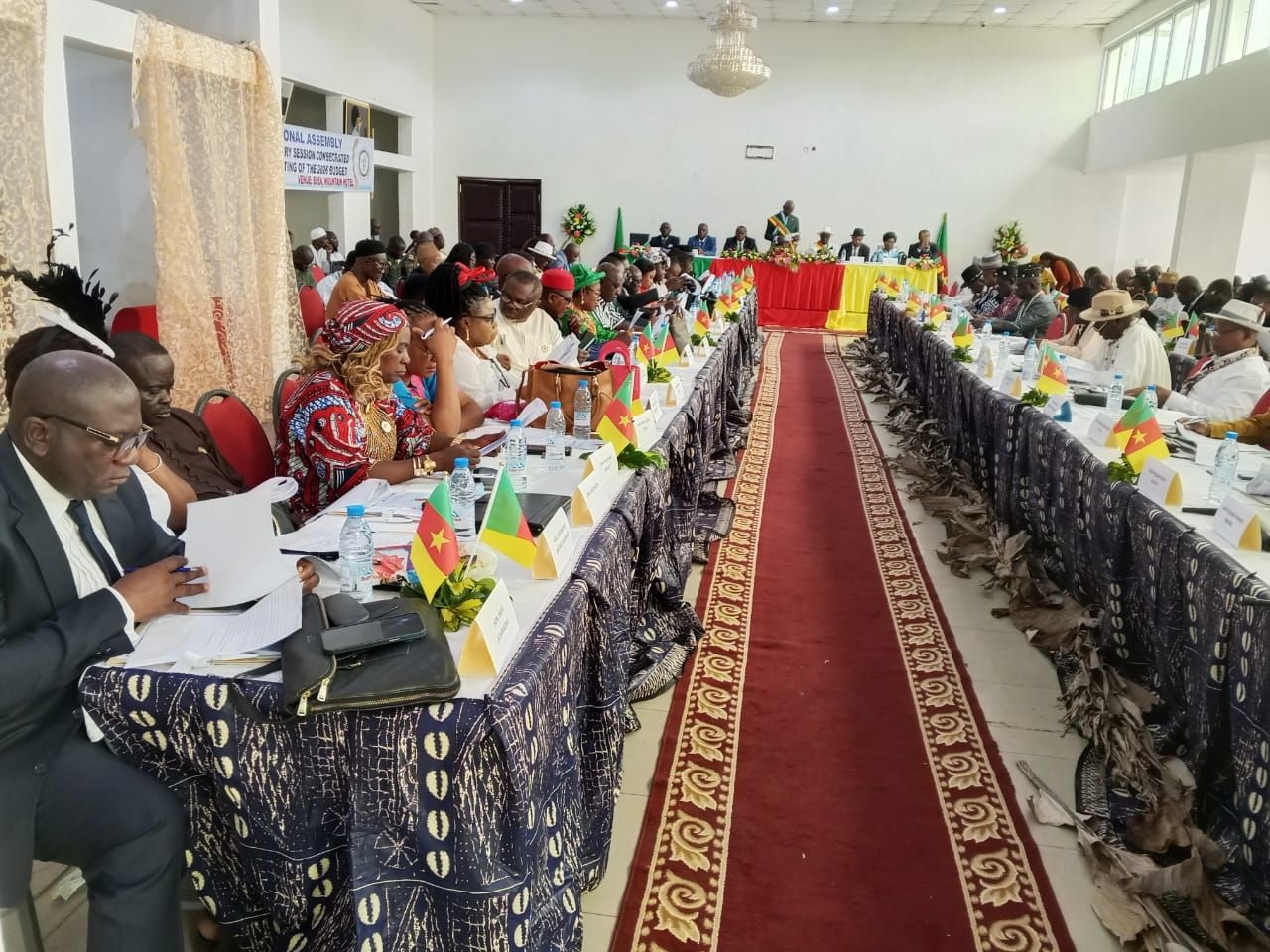
The President of the South West Regional Executive Council, Bakoma Elango Zacheus, has presented a balanced budget of FCFA 15.2 billion for the 2026 financial year, outlining an ambitious plan to implement large-scale development projects across the region.
The proposal was introduced during the 2026 Budget Session of the South West Regional Assembly in Buea on the 3rd March . According to the Assembly President, the new financial framework represents a major increase compared to previous years when the institution operated with budgets ranging between FCFA 3 billion and FCFA 4 billion.
He noted that the expanded budget would significantly improve the region’s ability to launch and complete major infrastructure and development initiatives.
The draft financial plan is balanced at FCFA 15,208,471,639 for both revenue and expenditure. Funding sources include more than FCFA 10 billion from local finances, government subvention, a FCFA 1 billion loan from FEICOM to support the construction of the Assembly’s headquarters, as well as internally generated revenue.
During his address, Bakoma expressed appreciation to Paul Biya for renewing his trust in him. He also acknowledged the role played by the Governor of the South West Region, Bernard Okalia Bilai, in overseeing the December 2025 session that resulted in the election of the current Regional Executive Council.
Regarding spending priorities, 70 percent of the budget has been earmarked for investment projects, while the remaining 30 percent will finance operational and administrative costs. Key focus areas include the improvement of basic social services, economic growth initiatives, environmental protection, governance and administrative management, as well as programs supporting youth, culture and sports.
One of the most significant projects highlighted is the construction of the permanent headquarters of the South West Regional Assembly. The project officially commenced on February 24, 2026, following the installation of Chariot Company Ltd on a two-hectare construction site.
The building complex is estimated to cost about FCFA 8 billion and will consist of 11 structures. Authorities project that the entire project will take approximately five to six years to complete. According to the Assembly President, nearly FCFA 2 billion has already been mobilized for the initial phases, with an additional FCFA 1 billion allocated for the current year.
Several other development initiatives were also announced. These include the construction of new classroom blocks, a multipurpose facility at Konye District Hospital, a four-theatre surgical complex at the Kumba Regional Hospital, and the first phase of a Government Technical College in Ekondo Titi.
In addition, road maintenance and bridge construction projects are expected to be carried out under funding from the Road Fund and the World Bank-supported PROLOG initiative. These projects aim to improve connectivity between subdivisions in Meme, Ndian and Lebialem divisions.
Despite the optimism surrounding the development agenda, Bakoma raised concerns about contractor performance. He revealed that 11 contracts were terminated in 2025 due to unsatisfactory execution of projects.
He cautioned contractors against taking on more projects than they can effectively deliver, stressing that firms that fail to meet their obligations risk having their contracts cancelled.
Reacting to the proposed budget, Hon. Itoe Motanga John Paul welcomed the focus on road and bridge construction, saying the projects would significantly improve mobility between communities.
He explained that residents in several subdivisions have long struggled with poor road access, often relying on bush paths to travel between areas.
However, he also stressed the importance of ensuring that contractors carry out their assignments responsibly to avoid delays and incomplete projects.
Beyond financial discussions, the budget session also hosted a climate change conference for members of the South West House of Chiefs. The training session was facilitated by environmental journalist Robert Abunaw of the Cameroon Biodiversity Journalists Association.
During his presentation, Abunaw emphasized the importance of understanding climate science and encouraged chiefs to support climate adaptation efforts rather than waiting for the impacts to worsen.
He discussed the connections between deforestation, land degradation, food insecurity and health challenges, urging traditional authorities to champion reforestation and climate-smart agricultural practices in their communities. He also suggested creating a South West Chiefs Climate Change Action Association to coordinate environmental initiatives at the grassroots level.
The President of the South West House of Chiefs, Chief Kombe Richard Ndike, described the conference as a milestone event. He noted that it was the first time in Cameroon that traditional rulers had received a dedicated internal lecture on climate change, adding that the session provided valuable knowledge for all participants.
Ndike further revealed that discussions were underway to formalize cooperation with environmental experts through an official partnership agreement.

