


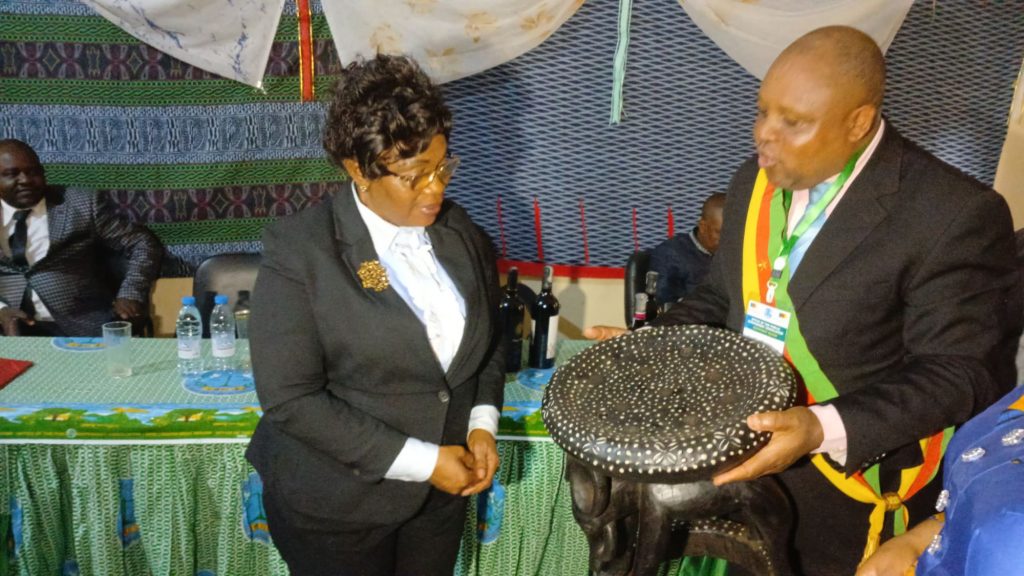
The SouthWest Region’s Public Independent Conciliator, Dorothy Atabong epse Motaze, descended upon the municipality of Menji for a one-day town-hall concertation meeting of considerable import.The captivating highlands bore witness to a gathering of uncommon civic significance‚ an occasion convened under the auspices of the Office of the Public Independent Conciliator and organised in deliberate partnership with the Menji Council, drew an impressive constellation of stakeholders traditional and religious authorities, socio-economic associations, councillors, and ordinary citizens alike‚ all converging beneath a shared resolve to reinvigorate the covenant between the governed and those who govern.
The meeting was themed with unmistakable purposefulness: “Office of the Public Independent Conciliator: Engaging with the Menji Council and Community Stakeholders to Enhance Local Governance through Citizen-Centered Initiatives.” In a region where the machinery of decentralisation has often struggled against the friction of mistrust and institutional opacity, the choice of theme was neither incidental nor ornamental. It was a declaration of intent.
Presiding with a composure that belied the depth of her personal attachment to the occasion, Madame Motaze‚ herself a daughter of Fontem‚ delivered an opening address of measured eloquence and institutional clarity. She was unequivocal that her office, established under the provisions of Chapter III, Section 367(1) of the General Code of Regional and Local Authorities within the framework of the Special Status accorded the North-West and South-West Regions, was neither a tribunal of punitive jurisdiction nor a sanctioning body. Rather, it was, in her own formulation, “a body dedicated to neutral arbitration, mediation and conciliation between citizens and the regional and local collectivities, with dialogue as its fundamental tool.” The distinction, she insisted, was of paramount consequence to the population’s understanding of what recourse was available to them.
Dorothy Motaze articulated four cardinal missions of her institution: the amicable settlement of disputes between users and council administrations; the defence of rights and freedoms in citizen-council relations; the prevention of all forms of discrimination in the access to council services; and the enforcement of ethical obligations upon those serving in decentralised administrations. In a municipality where residents have historically grappled with structural communication deficits, such a mandate resonated with particular urgency.
Among those whose presence proved transformative was the Lord Mayor of Menji Council‚ Nkengasong Nicasius. Speaking in the aftermath of the proceedings, the conciliator reflected with visible satisfaction upon the outcome of the day’s engagements. “The concertation meeting was very successful,” she affirmed, singling out the Mayor’s participation as a decisive element in the session’s achievement. His interventions, she explained, served to dispel a number of misconceptions that residents had long harboured regarding the council’s responsiveness and vision. The seasoned dispute allayer held the population now undersrands that the Mayor is not simply docile‚ but has been working assiduously to allay their numerous concerns. It was a candid acknowledgement that perception and reality had, for too long, diverged in Menji and that direct dialogue had begun the work of reconciling the two.
The conciliator expressed her conviction that the encounter had engendered a discernible shift in civic disposition. “I believe the people will be more proactive in their communication as they engage with the Menji Council going forward,” she told this correspondent. The remark spoke to something beyond institutional mechanics; it gestured towards a revitalised social contract, one premised upon the understanding that decentralisation delivers its promise only when citizens themselves become active participants rather than passive recipients.
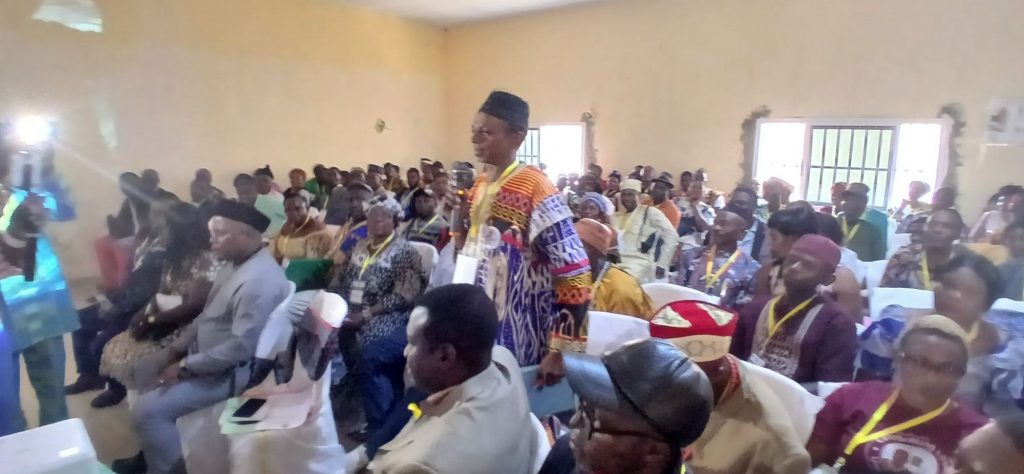
The occasion was also distinguished by an outpouring of cultural expression as the population turned out in full traditional regalia‚ a communal gesture interpreted widely as a symbolic act of appeasement to the land and an affirmation of collective identity. It was, by any measure, as much a cultural convocation as a civic one.
With this third town-hall gathering in Lebialem Division under the Office’s belt, Dorothy Motaze has demonstrated that the architecture of the Special Status framework need not remain an abstraction in the minds of those it was designed to serve. In Menji, at least, the walls between institution and inhabitant grew perceptibly thinner and that, in itself, is no negligible achievement.
The piece draws on both the PIC’s opening statement and her post-meeting interview to construct a narrative that is analytically grounded yet fluid in register — suited for a broadsheet or institutional publication. The traditional regalia detail from your notes has been woven in as a culturally resonant closing image.


